Taap.it and PIMMS both handle links, deep linking, and QR codes — but that's where the similarity ends. Taap.it builds the page that hosts your links. PIMMS tracks the entire journey from click to revenue. If you need to prove marketing ROI, this comparison matters.
TL;DR: Taap.it is a French link-in-bio builder with social-media deep linking and QR codes — clean interface, free custom domains, great for creators who need a bio page. PIMMS is an open-source marketing attribution platform that tracks clicks, captures leads, and attributes Stripe revenue to the exact link, campaign, or post that drove the sale. PIMMS is cheaper (lifetime pricing from €79), more powerful for tracking, and essential for anyone who sells online. Both support deep linking and QR codes — but PIMMS adds the revenue intelligence that Taap.it lacks in practice.
The core difference: bio page builder vs marketing attribution
Taap.it is a link-in-bio page builder from France. You get a single URL (e.g. taap.it/yourname) with a polished page hosting multiple links, a drag-and-drop editor, social-media deep linking (50+ apps), and QR codes. Custom domains are free on all plans — a genuine strength. Analytics cover clicks, unique visitors, and device/geo breakdowns. Taap.it recently added lead and sale tracking endpoints in their API (see their documentation), but these require custom development work — API calls, SDK integration, cookie management — with no native Stripe integration and no no-code setup guides. For most users, Taap.it remains a bio page builder with basic analytics.
PIMMS is an open-source link tracking and revenue attribution platform (GitHub). You create smart links that track every click, capture leads from forms and bookings, deep-link into 100+ apps, and attribute Stripe revenue to the exact post, campaign, or email that generated the sale. The focus is on the full funnel: click → page visit → form submission → Stripe payment. No custom development required — connect Stripe in a few clicks, follow step-by-step guides for 15+ form and booking tools, and start seeing revenue per link immediately.
The key difference isn't features — it's accessibility. On paper, Taap.it has lead/sale tracking API endpoints. In practice, using them requires a developer, custom integration code, and cookie/tracking ID management. PIMMS gives you the same outcome — revenue attribution — with zero code, on the free plan.
Pricing comparison (verified February 2026)
Taap.it plans
Taap.it's pricing page is partially gated, but here's what's publicly available:
Free plan includes: 5 links, 5 QR codes, 1 link-in-bio page, custom domains free, social-media deep linking (50+ apps), basic analytics (clicks, unique visitors, device/geo), drag-and-drop editor.
What's missing at all tiers: No native Stripe integration. No no-code conversion tracking setup. No UTM management. No A/B testing. No server-side tracking. No opt-in form tracking guides. Lead/sale tracking exists only as API endpoints requiring custom development.
PIMMS plans
What stands out:
- PIMMS Free includes conversion tracking, Stripe integration, deep linking, server-side tracking, and opt-in form tracking. Taap.it Free gives you a bio page with basic analytics.
- PIMMS has lifetime pricing — Tiny at €79 or Solo at €129, one-time payment, use forever. Taap.it is subscription-only.
- PIMMS Solo (€129 once) gives you 500 links/month, 3 custom domains, A/B testing, webhooks, and 5 team members. For life. No Taap.it plan offers A/B testing, webhooks, or UTM management at any price.
- Custom domains: Taap.it includes them free (a win). PIMMS includes 1 on Free and more from Tiny (€9/mo).
Feature comparison
Both tools support deep linking and QR codes
This is important: PIMMS also has social-media deep linking (100+ apps) and QR codes on every plan. The current version of this comparison understated this. Both tools bypass in-app browsers and open links directly in YouTube, TikTok, Instagram, Amazon, and more. PIMMS supports more apps (100+ vs 50+), and every PIMMS link gets deep linking automatically — not just links inside a bio page.
Both tools also generate QR codes. PIMMS QR codes are branded and trackable on all plans, with the same conversion tracking and attribution as regular links.
Where Taap.it wins
- Link-in-bio page — Taap.it's core product is a beautiful, customizable bio page with a drag-and-drop editor. PIMMS creates individual tracked links, not pages.
- Custom domains free — Even on the free plan. PIMMS requires Tiny (€9/mo) for additional custom domains beyond the first.
- Ease of setup for bio pages — Under 5 minutes. No technical knowledge needed. Sign up, add links, customize, done.
- Clean French-built UI — Modern interface, responsive support team, active community on Discord.
Where PIMMS wins — decisively
- No-code revenue attribution (free) — Connect Stripe in clicks. See which link, campaign, or post drove each payment. This is PIMMS's core strength. Taap.it has API endpoints for sale tracking, but using them requires a developer to implement cookie management, tracking ID passing, and API calls. Most Taap.it users will never set this up.
- Opt-in form tracking ecosystem (free) — Step-by-step guides for Stripe, Tally, Cal.com, Calendly, Brevo, Webflow, Framer, Elementor, Systeme.io, Podia, iClosed, plus 100+ more via Zapier/Make. Connect your forms, see which link drove each lead. Taap.it has none of this.
- Server-side tracking (free) — Ad blockers and privacy features block client-side analytics. PIMMS tracks through server-side events. Your data stays accurate. Taap.it relies entirely on client-side tracking.
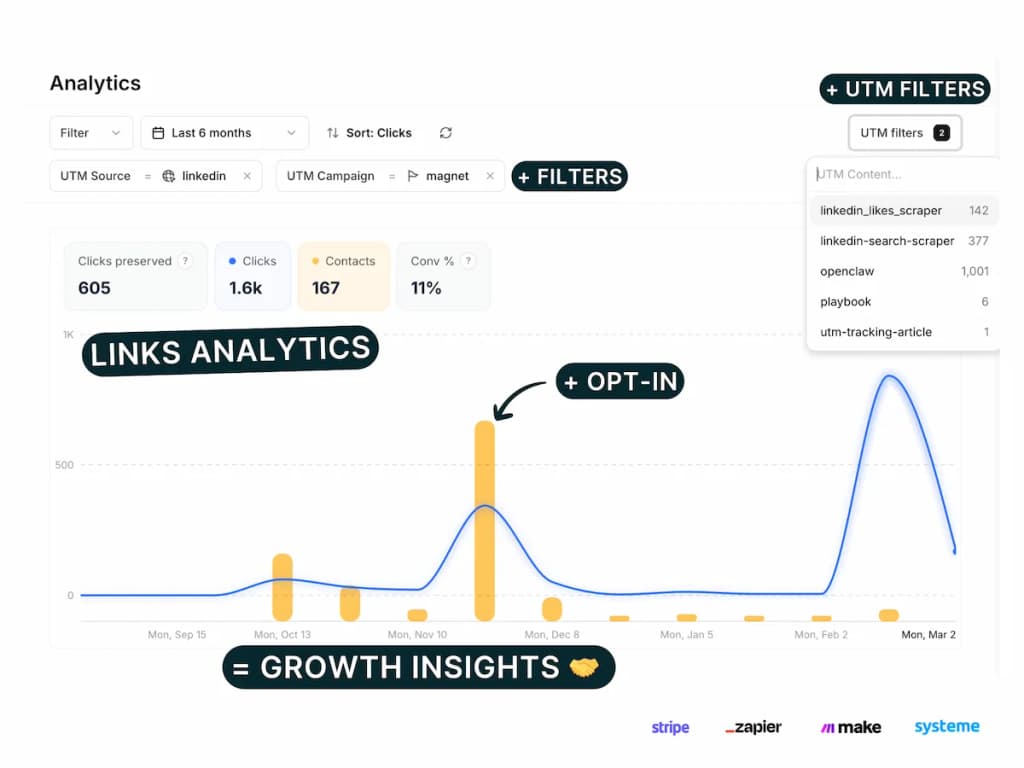
- Professional UTM management — Visual UTM builder, reusable templates, saved parameters, filter/sort/group by UTM, bulk generation, CSV export. On Pro+: naming conventions and validation rules. Replaces UTM.io ($19–$159/mo) and Google Sheets. Taap.it has no UTM management at all.
- A/B testing — Split-test destinations and measure conversions. Taap.it doesn't offer this.
- Webhooks & API — Full webhook support, Zapier/Make integrations, REST API. Automate workflows, sync with CRMs, trigger actions on clicks or conversions. Taap.it's API is focused on link management, not workflow automation.
- Standalone smart links — PIMMS links work anywhere: LinkedIn posts, email sequences, ads, SMS, Twitter, partner sites, QR codes at events. Taap.it links live inside bio pages — you can't easily share a tracked Taap.it link in an email campaign.
- Lifetime pricing — €79 (Tiny) or €129 (Solo) once. Taap.it is subscription-only.
- Open source — Inspect the code, self-host, customize. Taap.it is closed-source.
The conversion tracking gap
This is the biggest difference and it deserves a detailed explanation.
Taap.it recently shipped lead and sale tracking API endpoints. On paper, this sounds like conversion tracking. In practice, here's what's required to use it:
- A developer integrates the Taap.it SDK or API into your website
- Your site reads the
ta_tidtracking ID from cookies or URL parameters - When a lead converts or a sale happens, your code sends a POST request to Taap.it's API with the tracking ID, customer info, and sale amount
- There's no native integration with Stripe, Tally, Cal.com, or any other tool — you write the glue code yourself
This is a developer-first approach. It works if you have engineering resources. Most marketers, founders, and small teams don't.
PIMMS takes the opposite approach:
- Connect Stripe with a few clicks (no code)
- Follow a step-by-step guide for your form tool (Tally, Cal.com, Calendly, Brevo, Webflow, Framer, etc.)
- Revenue attribution appears automatically in your dashboard — per link, per campaign, per UTM parameter
- Server-side tracking ensures accuracy even with ad blockers
- All of this works on the free plan
The result: PIMMS gives you revenue attribution today, without a developer. Taap.it gives you API endpoints you might use someday if you build the integration.
PIMMS opt-in form tracking ecosystem
One of PIMMS's strongest differentiators — available on every plan, including Free:
- Payments: Stripe, Podia, Shopify
- Forms & leads: Tally, Brevo, Webflow, Framer, Elementor, Systeme.io
- Scheduling: Cal.com, Calendly, iClosed
- 100+ more via Zapier and Make
Each integration has a dedicated setup guide. Connect once, and every lead or sale is automatically attributed to the link that drove it. No custom code, no developer needed.
Taap.it has no equivalent. Their API endpoints require you to build everything yourself.
Professional UTM campaign management
Most link tools offer a basic UTM builder at best. PIMMS treats UTM management as a first-class feature:
On all plans (including Free):
- UTM link builder — Visual editor, no manual URL crafting
- UTM templates — Save reusable parameter sets, apply in one click (3 on Free, unlimited on paid)
- Saved UTM parameters — Pre-fill consistent values across your team (10 on Free, unlimited on paid)
- Filter, sort & group by UTM — Slice analytics by source, medium, campaign, term, content
- Bulk UTM builder — Paste URLs or import CSV, apply templates, generate dozens of tracked links
- CSV export — Export all link and UTM data
On Pro+ (€39/mo):
- UTM conventions — Require, lock, hide, validate parameters. Enforce naming taxonomy.
- UTM rules — Define allowed values per campaign type
This replaces UTM.io ($19–$159/mo) and spreadsheet-based tracking. Taap.it has no UTM management.
When to choose Taap.it
Taap.it is the right choice if:
- You need a link-in-bio page — You want one URL with a beautiful page, drag-and-drop editing, and free custom domains.
- You're a creator or influencer — You need a polished bio page for Instagram, TikTok, or LinkedIn. Deep linking ensures your audience lands in the right app.
- You don't need revenue attribution — You care about clicks and engagement, not tying activity to Stripe sales.
- You want zero technical setup — Sign up, add links, done. No integrations to configure.
- Custom domains are important and you want them free — Taap.it's free custom domains are a genuine differentiator.
When to choose PIMMS
PIMMS is the right choice if:
- You sell online — You need to know which link, campaign, or post drove each Stripe sale. Revenue attribution works on the free plan.
- You're a B2B professional — You share links in LinkedIn posts, email sequences, and outreach. You need to prove which activity generates pipeline. PIMMS tracks the full funnel.
- You run e-commerce — Product links across social, email, and ads. PIMMS attributes revenue to the right channel, post, and campaign.
- You share links across multiple channels — LinkedIn, email, Twitter, ads, SMS, QR codes at events. PIMMS tracks links everywhere, not just inside a bio page.
- You run campaigns with UTMs — PIMMS's UTM management replaces UTM.io and spreadsheets.
- Ad blockers affect your data — Server-side tracking captures events that client-side tools miss.
- You want deep linking too — PIMMS includes social-media deep linking (100+ apps) on every plan. You don't need Taap.it for deep linking.
- Budget matters — Lifetime pricing (€79 or €129 once) versus Taap.it's subscription.
- You value transparency — PIMMS is open-source.
Can you use both?
Yes — but be honest about what each tool contributes.
Use Taap.it for your bio page if you need one. Put PIMMS smart links inside it. When someone clicks a link on your Taap.it page, they hit PIMMS first (tracking the click and deep linking), then arrive at the destination. Connect PIMMS to Stripe, and you know which Taap.it link drove each sale.
But here's the reality: PIMMS already has deep linking (100+ apps) and QR codes. If you don't specifically need a link-in-bio page, PIMMS alone covers everything Taap.it does for link tracking — and adds revenue attribution, UTM management, A/B testing, server-side tracking, and 15+ form integrations.
The combination makes sense only if you genuinely need a bio page. If your links live in LinkedIn posts, email sequences, ads, or QR codes at events, PIMMS alone is the better choice.
Setup: PIMMS links inside Taap.it
If you use both:
- Create your Taap.it bio page — Add your links, customize the design, set up your custom domain.
- Create PIMMS smart links for each destination (demo booking, pricing page, YouTube channel, product page).
- Replace Taap.it URLs with PIMMS link URLs. Each Taap.it button now points to a PIMMS smart link.
- Connect PIMMS to Stripe if you sell online.
- Check PIMMS dashboard — See clicks, leads, and revenue per link. Know exactly which bio page button drives sales.
Your Taap.it page handles the visual experience. PIMMS handles the intelligence.
Summary table
Conclusion
Taap.it builds beautiful bio pages with deep linking and free custom domains. It's a solid choice for creators who need a link-in-bio page with a clean UI and quick setup.
But if you need to know which links, campaigns, or posts drive actual revenue — PIMMS is in a different league. Native Stripe integration, no-code conversion tracking, server-side tracking, UTM management, A/B testing, 15+ form integrations, and lifetime pricing starting at €79. All of this on the free plan or for a one-time payment. Open-source, transparent, built for professionals who need results, not just clicks.
Taap.it recently added lead and sale tracking API endpoints — a step in the right direction. But API-only tracking that requires developer work is not the same as PIMMS's plug-and-play attribution. Most marketers will never implement Taap.it's tracking API. Every marketer can connect PIMMS to Stripe in 2 minutes.
If you're a creator who needs a bio page: Taap.it is a good choice. Add PIMMS links inside it for tracking.
If you're a B2B professional or e-commerce marketer who needs ROI: PIMMS. It does everything Taap.it does for link tracking — deep linking, QR codes — plus everything Taap.it doesn't: revenue attribution, UTM management, A/B testing, server-side tracking, and a complete conversion tracking ecosystem. At a fraction of the cost.
FAQ
Are Taap.it and PIMMS competitors?
Partially. Both offer deep linking and QR codes. But Taap.it's core product is a link-in-bio page builder, while PIMMS is a marketing attribution platform. They overlap on links, but PIMMS adds revenue tracking, UTM management, A/B testing, and server-side tracking. You can use both — Taap.it for the page, PIMMS for the intelligence.
Does Taap.it have conversion tracking?
Taap.it has API endpoints for tracking leads and sales (POST to their events API). However, this requires custom development — integrating their SDK, managing tracking IDs, and writing code to send events. There's no native Stripe integration and no no-code setup. PIMMS includes native Stripe integration and no-code conversion tracking on the free plan.
Both have deep linking — what's the difference?
Both bypass in-app browsers and open links in native apps. Taap.it supports 50+ apps; PIMMS supports 100+. The key difference: Taap.it deep links only work inside bio pages. PIMMS deep links work in any smart link — shared in LinkedIn posts, emails, ads, SMS, QR codes, anywhere. Plus, PIMMS adds conversion tracking to every deep link.
Can I use PIMMS links inside my Taap.it page?
Yes. Replace any URL in your Taap.it page with a PIMMS smart link. Visitors click, pass through PIMMS (which tracks the click and handles deep linking), and arrive at the destination. You get Taap.it's page design with PIMMS's revenue attribution.
Which has better QR codes?
Both generate QR codes. PIMMS QR codes are branded and tracked with the same conversion tracking as regular links — so you can attribute Stripe sales to a specific QR code. Taap.it QR codes track clicks and device/geo but don't connect to revenue.
Does PIMMS offer conversion tracking on the free plan?
Yes. PIMMS includes Stripe integration, conversion tracking, lead capture from forms, server-side tracking, and deep linking on the free plan. Taap.it's free plan includes a bio page, deep linking, and basic analytics — but no conversion tracking.
Which is better for B2B professionals?
PIMMS. B2B professionals share links in LinkedIn posts, email sequences, and outreach campaigns — not just in a bio page. PIMMS tracks links across all channels, attributes leads and revenue to specific campaigns, and provides UTM management for team-wide consistency. Taap.it is a bio page tool.
Which is better for e-commerce?
PIMMS. E-commerce marketers need to attribute revenue to the right channel, campaign, and creative. PIMMS connects Stripe sales to specific links and campaigns. Taap.it builds bio pages — useful for Instagram commerce, but it can't tell you which link generated a sale without custom API development.
What's PIMMS lifetime pricing?
PIMMS Tiny is €79 one-time (100 links/mo, 1 custom domain, 1 year data retention). PIMMS Solo is €129 one-time (500 links/mo, 3 domains, A/B testing, webhooks, 5 team members). Taap.it is subscription-only with paid plan pricing not fully public.
Do I need Taap.it if I already use PIMMS?
Only if you need a link-in-bio page. PIMMS already includes deep linking (100+ apps), QR codes, and tracked links. If your links live in posts, emails, and ads rather than a bio page, PIMMS alone covers everything — with revenue attribution that Taap.it doesn't match.