
What is Multi-Touch Attribution?
Multi-touch attribution is a marketing measurement method that assigns credit to multiple touchpoints across the customer journey, rather than attributing a conversion to a single interaction. According to a 2024 study by Forrester Research, 78% of B2B buyers interact with 7 or more touchpoints before making a purchase decision, making single-touch attribution increasingly inadequate for modern marketing measurement.
Unlike last-click attribution which gives 100% credit to the final interaction, multi-touch models recognize that customers engage with multiple channels before converting. This approach provides a more accurate picture of how your marketing channels work together to drive conversions.
Why Multi-Touch Attribution Matters in 2026
The marketing landscape has fundamentally changed. According to Google's 2024 Consumer Journey Report, the average customer journey now involves 3.2 devices, 8.4 touchpoints, and takes 14 days from first awareness to conversion. Single-touch attribution models miss this complexity entirely.
Key statistics from recent research:
- 78% of marketers report that multi-touch attribution changed their channel investment decisions, according to a 2024 Gartner Marketing Attribution Survey
- Companies using multi-touch attribution see an average 15-30% improvement in marketing ROI compared to last-click models, per Nielsen's 2024 Marketing Mix Modeling Study
- 64% of marketing budgets are now allocated across 5+ channels, up from 42% in 2022, according to CMO Survey 2024
The problem with single-touch models: they systematically undervalue top-of-funnel activities like content marketing, social media, and awareness campaigns. A brand that runs YouTube ads might see zero conversions attributed to YouTube with last-click attribution, when in reality those ads introduced 40% of eventual customers to the brand.
The 7 Multi-Touch Attribution Models Compared
1. Linear Attribution
How it works: Distributes credit equally across all touchpoints in the customer journey.
Formula: Each touchpoint receives 1/n credit, where n = total touchpoints
Example journey:
Google Ads → Blog Post → Email → Webinar → Demo → Purchase ($1,000)
Credit: $166.67 to each touchpoint
Best for:
- Long sales cycles (3+ months)
- Complex B2B journeys with many touchpoints
- Teams that want simple, unbiased attribution
Limitations:
- Treats all touchpoints as equally important
- Doesn't account for touchpoint timing or quality
- May overvalue low-intent interactions
Data requirements:
- Full customer journey tracking
- Minimum 30 days of historical data
- Cross-device/cross-platform tracking capability
Real-world use case: A SaaS company with a 90-day sales cycle discovered through linear attribution that their podcast sponsorships appeared in 42% of closed deals, leading to a 3x increase in podcast ad spend. The previous last-click model had shown podcasts driving only 4% of conversions.
2. Time Decay Attribution
How it works: Assigns progressively more credit to touchpoints closer to conversion, using an exponential decay function.
Formula: Touchpoints receive credit based on e^(t × λ), where t = time before conversion and λ = decay rate
Standard decay: 7-day half-life (touchpoint 7 days before conversion gets 50% of the credit of the final touchpoint)
Example journey:
Day 1: Social Media (10% credit)
Day 8: Blog Post (18% credit)
Day 15: Email (32% credit)
Day 16: Purchase ($1,000) - Demo Call (40% credit)

Credit distributed: $100, $180, $320, $400
Best for:
- Sales cycles with clear momentum phases
- E-commerce with consideration periods
- Teams optimizing for conversion rate
Limitations:
- Undervalues awareness-stage touchpoints
- May miss brand-building activities
- Assumes recency equals importance
Data requirements:
- Timestamp data for all interactions
- Session-level tracking
- Minimum 60 days of journey data
Implementation tip: Most analytics platforms default to a 7-day half-life, but you should calibrate this to your actual sales cycle. B2B companies with 6-month cycles often use 30-day half-life for more accurate attribution.
3. Position-Based (U-Shaped) Attribution
How it works: Assigns 40% credit to first touch, 40% to last touch, and distributes the remaining 20% across middle touchpoints.
Example journey:
LinkedIn Ad (First: 40%) → Blog Post (10%) → Email (10%) → Demo (Last: 40%)
For $1,000 sale: $400, $100, $100, $400
Best for:
- Teams valuing both acquisition and conversion
- Balanced view of top and bottom funnel
- Organizations with clear first and last interactions
Limitations:
- Arbitrary 40/40/20 split
- Middle touchpoints often undervalued
- Doesn't account for journey complexity
Data requirements:
- Clear first-touch identification
- Session stitching across devices
- Conversion point tracking
Customization: Many teams adjust the U-shape based on their data. A common variation is 30/30/40 (first/last/middle) for longer journeys with more consideration touchpoints.
4. W-Shaped Attribution
How it works: Extends U-shaped by adding a third key milestone. Assigns 30% credit to first touch, 30% to lead conversion, 30% to opportunity creation, and 10% distributed across other touchpoints.
Example journey:
Google Search (First: 30%) → Blog (5%) → Ebook Download (Lead: 30%)
→ Email (5%) → Demo Request (Opportunity: 30%) → Close ($10,000)

Credit: $3,000, $500, $3,000, $500, $3,000
Best for:
- B2B companies with defined funnel stages
- Marketing and sales alignment initiatives
- Organizations using CRM with clear opportunity stages
Limitations:
- Requires defined lead and opportunity stages
- Complex to implement without proper CRM
- May not fit all business models
Data requirements:
- CRM integration (Salesforce, HubSpot, Pipedrive)
- Clear stage definitions
- Marketing-to-sales handoff tracking
When to use W-shaped: According to a 2024 study by SiriusDecisions, 67% of B2B companies using multi-touch attribution chose W-shaped models because they align attribution with their existing funnel stages.
5. Z-Shaped (Full-Path) Attribution
How it works: Similar to W-shaped but adds the final purchase touchpoint. Distributes credit: 22.5% first touch, 22.5% lead creation, 22.5% opportunity creation, 22.5% close, and 10% to remaining touchpoints.
Best for:
- Complex B2B with long sales cycles
- Organizations with multi-stage approval processes
- Teams tracking deal acceleration
Limitations:
- Most complex single-rule model
- Requires sophisticated tracking
- Harder to explain to stakeholders
Data requirements:
- Full CRM pipeline integration
- Closed-loop reporting
- Attribution window of 6-12 months
6. Algorithmic (Data-Driven) Attribution
How it works: Uses machine learning to assign credit based on actual impact of each touchpoint. Analyzes thousands of conversion and non-conversion paths to determine which touchpoints statistically increase conversion probability.
How it's calculated: Machine learning models compare journeys that convert vs. don't convert, identifying which touchpoints increase conversion likelihood and by how much. Credit is assigned proportionally to statistical impact.
Example insight: An algorithmic model might discover that visitors who view a pricing page and then attend a webinar convert at 8.2x the baseline rate, while those who only attend the webinar convert at 2.1x baseline. Credit is automatically weighted to reflect these differences.
Best for:
- Large datasets (10,000+ monthly conversions)
- Multiple channels with complex interactions
- Teams with data science resources
Limitations:
- Requires significant data volume
- "Black box" nature makes it hard to explain
- Model can be disrupted by major campaign changes
- Need statistical expertise to validate results
Data requirements:
- Minimum 10,000 conversions for reliable models
- Complete journey data with no significant gaps
- Regular model retraining (monthly or quarterly)
Available in:
- Google Analytics 4 (formerly Google Analytics 360)
- Adobe Analytics
- Salesforce Marketing Cloud
- Custom implementations using Python (scikit-learn, TensorFlow)
Real-world example: According to a 2024 case study by Google, a retail brand using algorithmic attribution discovered that podcast ads had 4.2x more impact than their rule-based model suggested, leading to a reallocation of $800K in ad spend that increased overall ROAS by 34%.
7. Custom Rule-Based Attribution
How it works: You define your own rules based on business logic, touchpoint types, or channel characteristics.
Example custom rules:
- Paid channels get 2x weight vs. organic
- Demo calls receive 3x credit vs. other touchpoints
- Channels initiated by the customer (direct, organic) weighted higher
- Attribution windows vary by channel (30 days for content, 7 days for ads)
Best for:
- Unique business models not fitting standard models
- Organizations with strong attribution hypotheses
- Testing and learning phases
Limitations:
- Risk of introducing bias
- Requires continuous refinement
- May not scale as channels grow
Data requirements:
- Flexible attribution platform
- Ability to tag touchpoints by type/category
- Regular performance reviews
Comparison Table: Which Model to Choose
How to Choose Your Attribution Model
Step 1: Assess Your Sales Cycle
Short cycle (0-7 days):
- E-commerce, impulse purchases
- Recommended: Time Decay or Linear
- Focus on conversion optimization
Medium cycle (7-30 days):
- Considered purchases, B2C services
- Recommended: U-Shaped or Time Decay
- Balance awareness and conversion
Long cycle (30+ days):
- B2B, enterprise sales, complex products
- Recommended: W-Shaped, Z-Shaped, or Algorithmic
- Capture full journey complexity
Step 2: Evaluate Data Availability
Limited data (<1,000 monthly conversions):
- Start with Linear or Time Decay
- Focus on data collection infrastructure
- Plan for model sophistication over time
Moderate data (1,000-10,000 conversions):
- Implement U-Shaped or W-Shaped
- Begin tracking stage progression
- Consider CRM integration
Rich data (>10,000 conversions):
- Explore Algorithmic models
- Invest in data science resources
- Run parallel models for comparison
Step 3: Align with Business Goals
Goal: Grow awareness → Use models that credit top-of-funnel (Linear, U-Shaped)
Goal: Improve conversion rate → Use models emphasizing bottom-funnel (Time Decay, W-Shaped)
Goal: Understand full journey → Use comprehensive models (Z-Shaped, Algorithmic)
Goal: Align marketing and sales → Use CRM-integrated models (W-Shaped, Z-Shaped)
Implementation Guide
Phase 1: Tracking Foundation (Weeks 1-4)
Week 1-2: Audit current tracking
- Verify all marketing channels are tagged
- Implement UTM parameter standards
- Set up cross-device tracking
- Configure conversion goals
Week 3-4: Fill tracking gaps
- Add missing channel tracking
- Implement server-side tracking for accuracy
- Set up form submission tracking
- Enable e-commerce or CRM integration
Phase 2: Choose and Configure Model (Weeks 5-6)
Week 5: Model selection
- Analyze sales cycle length
- Review data availability
- Align with stakeholder goals
- Document model choice and rationale
Week 6: Technical setup
- Configure attribution settings in analytics platform
- Set attribution windows (typically 30-90 days)
- Define conversion events
- Create reporting dashboards
Phase 3: Validation and Rollout (Weeks 7-8)
Week 7: Validate data
- Compare new model to baseline (last-click)
- Spot-check attribution logic with sample journeys
- Review with key stakeholders
- Adjust if needed
Week 8: Train and launch
- Train marketing team on new reports
- Document how to interpret attribution data
- Set review cadence (monthly recommended)
- Communicate changes to leadership
Multi-Touch Attribution with PIMMS
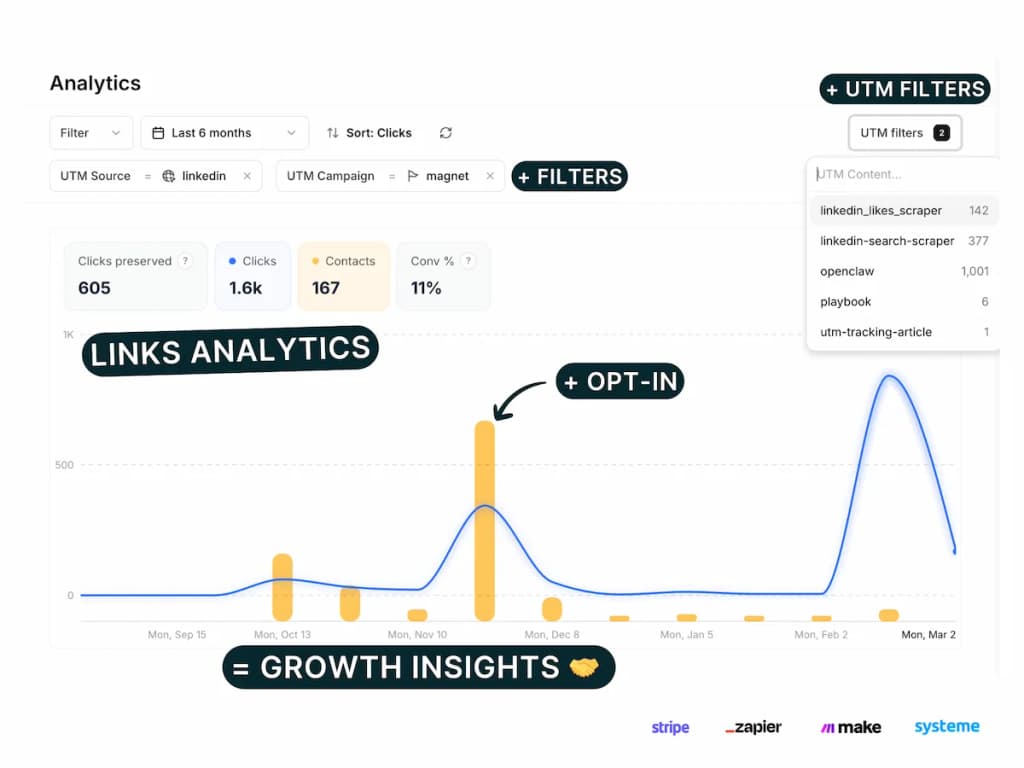
PIMMS provides built-in multi-touch attribution without requiring complex technical setup. Here's how it works:
Automatic journey tracking: Every link you create with PIMMS captures the full customer journey automatically. When someone clicks your link on LinkedIn, then returns via email, then converts via a direct visit, PIMMS connects all three touchpoints to the same person.
Flexible attribution models: View your conversions using different attribution models:
- Last-click (default for quick insights)
- First-click (see what's driving awareness)
- Linear (equal credit across all touchpoints)
- Time decay (more credit to recent interactions)
Revenue attribution: Connect Stripe or Shopify to attribute actual revenue to your marketing channels. See which campaigns and touchpoints contribute to paid conversions, not just form submissions.
No code required: Unlike enterprise attribution tools that require months of implementation, PIMMS works immediately:
- Create your smart links
- Share them in your campaigns
- View multi-touch attribution in your dashboard
For example, a SaaS founder using PIMMS discovered that 68% of their paid customers had clicked a Product Hunt link before converting via email — insight their previous analytics setup completely missed.
Common Multi-Touch Attribution Mistakes
Mistake 1: Ignoring Offline Touchpoints
The problem: Most attribution tools only track digital interactions, missing in-person meetings, phone calls, trade shows, and direct mail.
The fix: Use call tracking (CallRail, Invoca), CRM notes fields for offline touchpoints, and QR codes with UTM parameters for print materials. According to a 2024 study by Merkle, B2B companies that include offline touchpoints in attribution see 23% more accurate ROI calculations.
Mistake 2: Attribution Window Too Short
The problem: Default 30-day attribution windows miss long consideration cycles.
The fix: Match your attribution window to your actual sales cycle. For B2B SaaS, use 90-180 days. For enterprise, use 6-12 months. Research by Salesforce in 2024 found that 42% of B2B deals had their first touchpoint more than 90 days before close.
Attribution window by industry (2024 benchmarks):
- E-commerce: 7-30 days
- B2C services: 14-45 days
- SMB SaaS: 30-90 days
- Mid-market SaaS: 60-120 days
- Enterprise B2B: 90-270 days
Mistake 3: Treating All Touchpoints Equally When They're Not
The problem: Linear attribution treats a casual blog read the same as a product demo request.
The fix: Weight touchpoints based on intent signals. A demo request or pricing page view should receive more credit than a blog post read. Consider custom rule-based attribution or algorithmic models that automatically learn these differences.
Mistake 4: Not Accounting for Dark Social
The problem: Links shared in Slack, WhatsApp, or email appear as direct traffic, creating attribution blind spots.
The fix: Use link shorteners with UTM parameters for all shareable content. According to a 2024 study by Refinery89, dark social accounts for 84% of outbound sharing on mobile, making it critical to track.
Mistake 5: Changing Models Too Frequently
The problem: Switching attribution models every quarter makes trend analysis impossible.
The fix: Choose a primary model and stick with it for at least 6-12 months. Run secondary models in parallel for comparison, but don't change your decision-making framework constantly.
Frequently Asked Questions
What's the difference between multi-touch and multi-channel attribution?
Multi-touch attribution assigns credit across multiple touchpoints in a single customer's journey, regardless of channel. Multi-channel attribution specifically looks at how different marketing channels (email, social, paid search) contribute to conversions. Multi-touch is the methodology; multi-channel describes the scope. Most modern attribution is both multi-touch and multi-channel.
How much data do I need for multi-touch attribution?
For rule-based models (linear, time decay, U-shaped), you need a minimum of 100 conversions per month to see meaningful patterns. For algorithmic models, you need 10,000+ conversions annually for the machine learning to be statistically reliable. According to a 2024 study by Marketing Evolution, 72% of companies wait until they have at least 500 monthly conversions before implementing multi-touch attribution.
Can I use multi-touch attribution with a small marketing budget?
Yes. Multi-touch attribution is about measurement methodology, not budget size. Even if you're only running email and organic social, multi-touch attribution helps you understand which messages and channels drive conversions. PIMMS offers multi-touch attribution starting at €0/month, making it accessible for startups and small businesses.
Should I use different attribution models for different goals?
Yes, this is called multi-model attribution. Use last-click for immediate ROI decisions, first-click for awareness campaign evaluation, and linear for holistic journey insights. According to Nielsen's 2024 Marketing Attribution Report, 56% of enterprise marketing teams use multiple attribution models simultaneously to answer different business questions.
How do I explain multi-touch attribution to my CEO?
Use this analogy: "Imagine a soccer team where only the player who scored the goal got credit. You'd have no way to value the defense, midfield, or assists. Multi-touch attribution is like giving credit to the entire team based on their contribution to wins." Then show concrete examples: "Last month, last-click attribution said our blog drove $5K in revenue. Multi-touch shows it actually influenced $47K worth of deals — we were about to cut our content budget."
Does multi-touch attribution work for B2C?
Yes, but the models differ from B2B. B2C typically uses time decay or U-shaped models with shorter attribution windows (7-30 days vs. 90-180 days for B2B). E-commerce brands often use algorithmic attribution due to high conversion volumes. According to Shopify's 2024 Commerce Trends Report, 68% of direct-to-consumer brands use some form of multi-touch attribution.
Key Takeaways
Multi-touch attribution matters more than ever: With customers using an average of 3.2 devices and 8.4 touchpoints before converting (Google 2024), single-touch models miss the complete picture.
Start simple, evolve over time: Begin with linear or time decay attribution, collect data for 3-6 months, then graduate to more sophisticated models like U-shaped or algorithmic as your data matures.
Match the model to your business: Short sales cycles work well with time decay; long B2B cycles need W-shaped or Z-shaped; high-volume businesses can use algorithmic models.
Implementation takes 6-8 weeks: From tracking setup to validation, expect a 2-month project to implement multi-touch attribution properly. Tools like PIMMS can accelerate this to days instead of weeks.
Data quality beats model sophistication: A simple linear model with clean, complete data outperforms an algorithmic model with gaps in tracking. Focus on tracking infrastructure first, model complexity second.
Ready to implement multi-touch attribution without the complexity? PIMMS provides automatic journey tracking and flexible attribution models starting at €0/month, with setup taking minutes instead of months.